Finance SOPs: Guide, Examples & Free Template (2026)


Effective SOPs in Finance: A Comprehensive Guide to Compliance, Efficiency, and Audit Readiness
There's a ready-made version of this
Your SOP handbook is already live at yourcompany.dewstack.com: written, structured, searchable. Edit it, don't start it.
Preview itNo credit card. Edit it, don't start it.
Financial institutions face an unprecedented compliance burden. According to Thomson Reuters, financial services firms spend an average of $10,000 per employee annually on compliance-related activities. The regulatory landscape has expanded dramatically since the 2008 financial crisis, with the number of regulatory changes tracked by major financial institutions increasing by over 500% in the past decade. In this environment, Standard Operating Procedures (SOPs) are not merely administrative documents---they are the backbone of regulatory compliance, operational efficiency, and audit readiness.
Consider this: organizations with well-documented SOPs experience up to 67% fewer compliance violations and reduce audit preparation time by an average of 40%. Yet a survey by Deloitte found that nearly 60% of financial institutions struggle with outdated or inconsistent procedural documentation. The gap between regulatory expectations and operational reality can cost organizations millions in fines, remediation efforts, and reputational damage.
This comprehensive guide will transform how you approach financial SOPs, providing actionable frameworks for creating documentation that satisfies regulators, empowers employees, and protects your organization from costly compliance failures.
Key Takeaways
Before diving into the details, here are the essential insights you will gain from this guide:
- Compliance Cost Reality: Financial institutions spend between 6-10% of revenue on compliance activities, with documentation being a critical component of audit success
- Error Reduction: Well-implemented SOPs reduce financial processing errors by up to 67% and cut audit preparation time by 40%
- Regulatory Requirements: SOX Section 404 mandates documented internal controls, while GAAP requires consistent application of accounting procedures
- Essential SOP Categories: Every finance department needs documented procedures for reconciliation, financial reporting, compliance checks, and month-end close processes
- Implementation Success Factors: Training, change management, and regular review cycles are the three pillars of successful SOP adoption
- Technology Integration: Modern SOP creation software can reduce documentation time by 50% while improving accuracy and accessibility
Understanding the Critical Role of SOPs in Finance
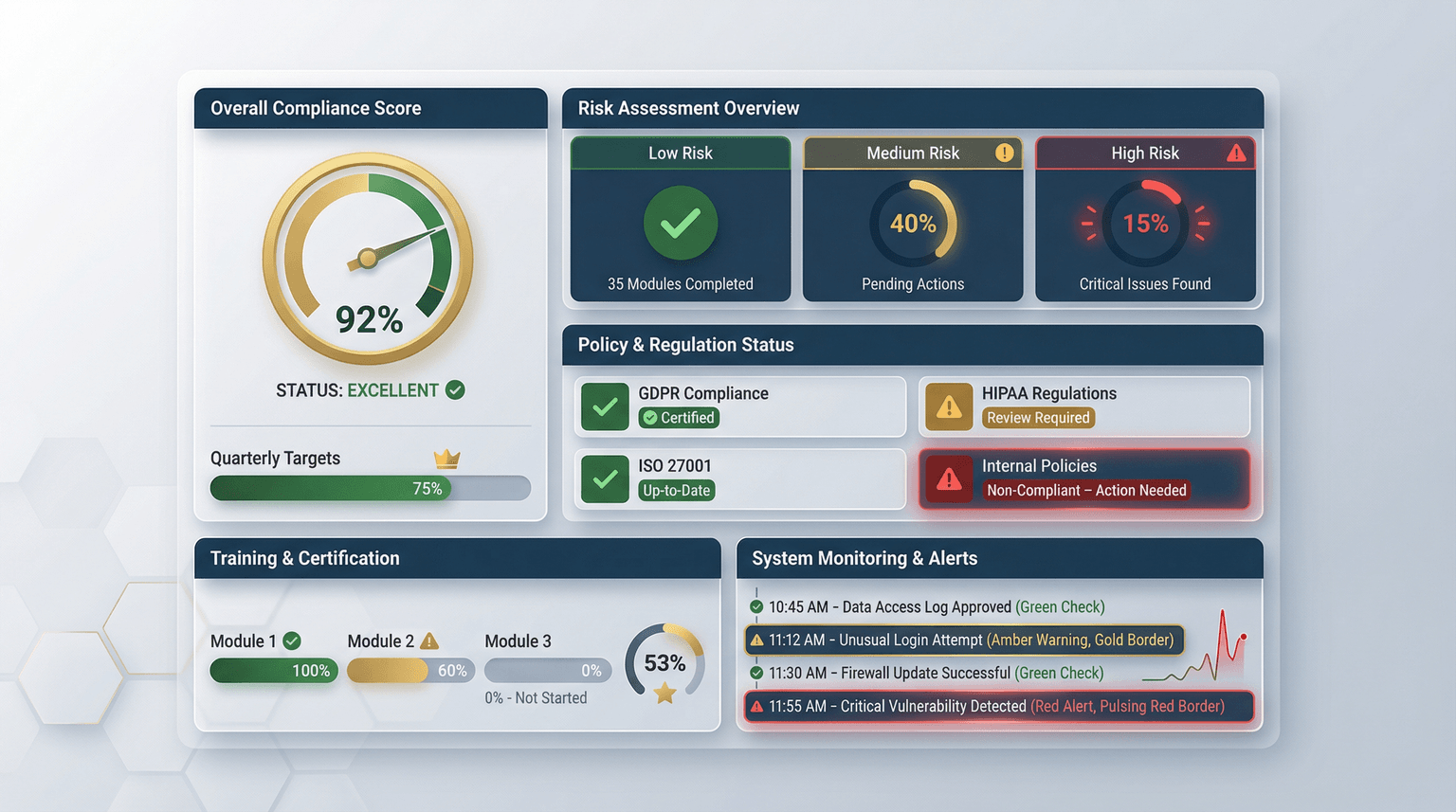
What Makes Financial SOPs Different
Standard Operating Procedures in finance carry a weight that SOPs in other industries simply do not. When a manufacturing SOP is poorly executed, you might produce a defective product. When a financial SOP fails, you risk regulatory penalties, audit failures, and potential criminal liability for executives under Sarbanes-Oxley requirements.
Financial SOPs must address multiple audiences simultaneously: the employee executing the task, the supervisor reviewing the work, the internal auditor validating controls, the external auditor assessing compliance, and the regulator evaluating organizational fitness. This multi-stakeholder environment demands documentation that is simultaneously detailed enough for execution and clear enough for verification.
The American Institute of CPAs (AICPA) reports that organizations with mature documentation practices are three times more likely to receive clean audit opinions. Furthermore, the SEC has increasingly cited inadequate documentation as a contributing factor in enforcement actions, with documentation-related findings appearing in over 40% of recent compliance orders.
The True Cost of Inadequate Documentation
The financial impact of poor SOPs extends far beyond the obvious regulatory fines. Consider these hidden costs that organizations often overlook:
Audit Remediation: When auditors identify control deficiencies related to documentation, remediation efforts typically cost between $50,000 and $500,000, depending on the scope of the finding. Organizations often spend three to five times more addressing a finding after the fact than they would have spent preventing it through proper documentation.
Employee Productivity Loss: Without clear SOPs, finance teams spend an estimated 20-30% of their time seeking clarification, correcting errors, or reinventing processes. For a finance department with 50 employees averaging $80,000 in salary, this represents $800,000 to $1.2 million in annual productivity loss.
Talent Management Challenges: High employee turnover in finance departments---averaging 15-20% annually according to Robert Half---compounds documentation problems. Each departure represents institutional knowledge walking out the door. Organizations with comprehensive SOPs report 50% faster onboarding times and 30% higher retention rates among finance staff.
Regulatory Examination Risk: Financial regulators increasingly use documentation quality as a proxy for overall control environment health. Poor documentation can trigger expanded examination scope, increased supervisory attention, and heightened scrutiny of other organizational activities.
The Regulatory Framework: SOX, GAAP, and SEC Requirements

Sarbanes-Oxley Compliance and Documentation
The Sarbanes-Oxley Act of 2002 fundamentally changed the documentation requirements for publicly traded companies. Section 404 requires management to assess and report on the effectiveness of internal controls over financial reporting, with external auditor attestation for larger companies. This requirement has created an entire ecosystem of documentation expectations that extend well beyond SOX-subject entities.
Section 404 Documentation Requirements: SOX requires that organizations document their internal controls sufficiently to allow an auditor to understand how transactions are initiated, authorized, recorded, processed, and reported. This documentation must include:
- Identification of significant accounts and relevant assertions
- Documentation of the flow of transactions through the system
- Identification of points where errors or fraud could occur
- Description of controls that address those risk points
- Evidence of control operation and monitoring
Management Certification Obligations: Sections 302 and 906 require CEO and CFO certifications regarding the accuracy of financial statements and the effectiveness of internal controls. These certifications carry personal liability, making comprehensive SOP documentation a personal priority for executive leadership.
Audit Trail Requirements: SOX mandates that organizations maintain documentation supporting financial statement assertions. SOPs must specify what documentation is created, how it is reviewed, where it is stored, and how long it is retained.
GAAP Compliance and Consistent Application
Generally Accepted Accounting Principles require consistent application of accounting methods across periods. This consistency mandate directly translates to SOP requirements:
Revenue Recognition (ASC 606): The five-step revenue recognition model requires documented policies for identifying contracts, identifying performance obligations, determining transaction prices, allocating prices to obligations, and recognizing revenue. Each step requires specific procedures that can be consistently applied and verified.
Lease Accounting (ASC 842): The current lease standard requires detailed procedures for lease identification, classification, measurement, and disclosure. Organizations have found that without comprehensive SOPs, lease accounting errors are among the most common financial statement adjustments.
Credit Loss Recognition (ASC 326): The current expected credit loss (CECL) model requires documented methodologies for estimating credit losses over the life of financial instruments. These methodologies must be consistently applied and supported by procedural documentation.
SEC Reporting and Disclosure Requirements
For SEC registrants, additional documentation requirements apply:
Form 10-K and 10-Q Preparation: The SEC expects that quarterly and annual reports be prepared according to documented procedures that ensure completeness, accuracy, and timely filing. Disclosure checklists and preparation timelines should be formalized in SOPs.
Material Event Reporting (Form 8-K): Procedures for identifying, escalating, and reporting material events within the required four-business-day window must be clearly documented and regularly tested.
Internal Control Reporting: Item 308 of Regulation S-K requires disclosure of material changes in internal controls. Organizations must have procedures for identifying, documenting, and reporting such changes.
Essential Components of Financial SOPs
The Seven Pillars of Effective Financial Documentation
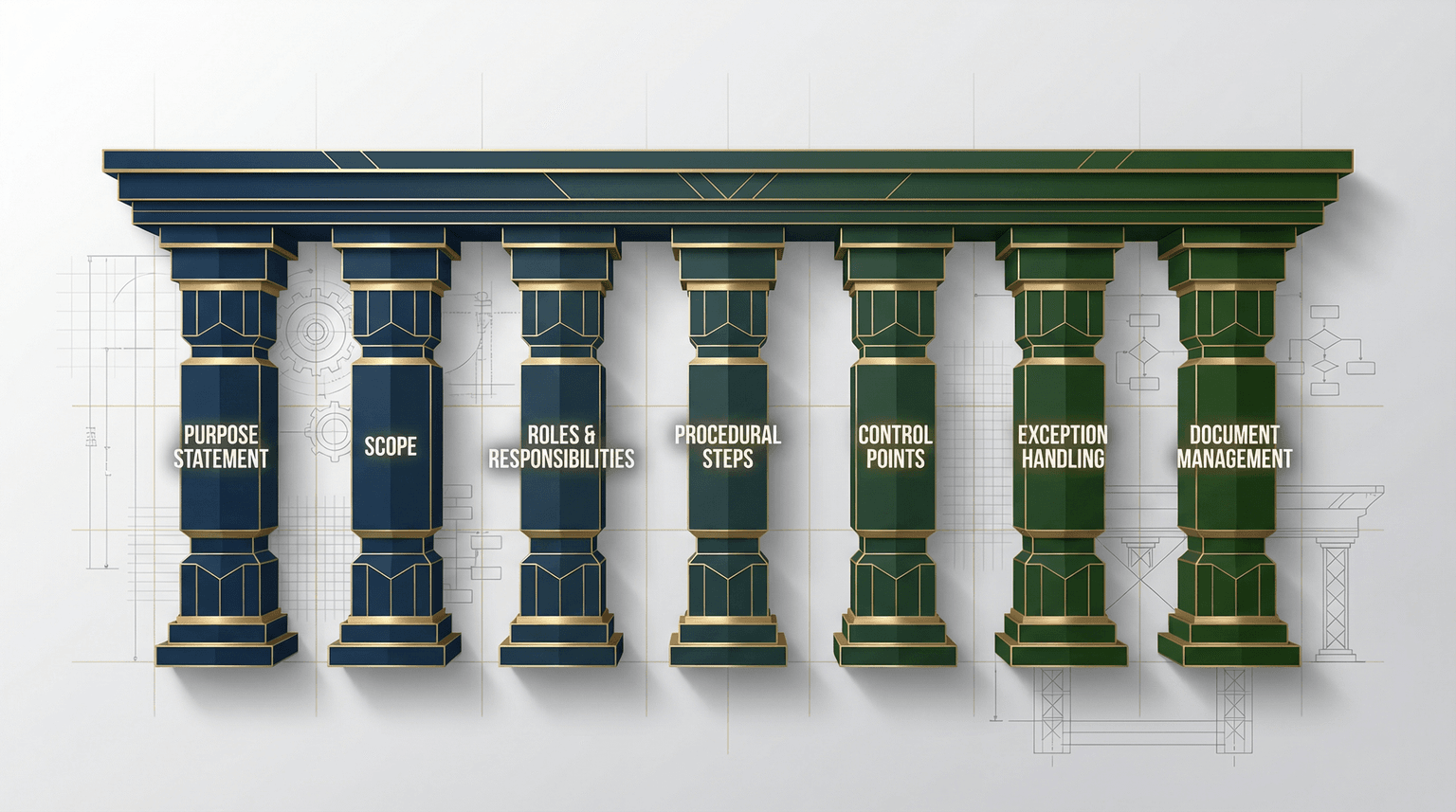
A well-crafted financial SOP must include seven essential components that together create a complete operational framework:
1. Purpose and Objective Statement Every SOP must clearly articulate why the procedure exists and what it aims to accomplish. This statement should connect the procedure to broader organizational goals and regulatory requirements. For example, a bank reconciliation SOP might state: "This procedure ensures accurate reconciliation of all bank accounts within five business days of month-end to support timely financial reporting and maintain compliance with SOX Section 404 requirements."
2. Scope and Applicability Define precisely what transactions, accounts, or activities the SOP covers. Specify any exclusions or exceptions and identify when alternative procedures apply. Clear scope definition prevents confusion about which procedures apply in specific situations.
3. Roles and Responsibilities Matrix Document who performs each step, who reviews and approves, and who has override authority. The RACI framework (Responsible, Accountable, Consulted, Informed) provides a useful structure for complex procedures involving multiple parties. Learn more about creating clear documentation that defines roles effectively.
4. Detailed Procedural Steps The heart of any SOP is the step-by-step procedure itself. Each step should specify:
- The action to be taken
- The system or tool used
- The inputs required
- The outputs produced
- The timing requirements
- The documentation created
5. Control Points and Verification Requirements Identify where controls are embedded in the process, what evidence of control operation is created, and how control effectiveness is monitored. This component is essential for audit readiness and regulatory compliance.
6. Exception Handling Procedures Document how to handle situations that fall outside normal parameters. Who has authority to approve exceptions? What documentation is required? How are exceptions tracked and reported?
7. Document Management Requirements Specify retention requirements, access controls, version management, and review schedules. Financial SOPs typically require retention periods of seven years or longer, depending on the jurisdiction and regulation.
Finance SOP Examples: Reconciliation, Reporting, and Compliance
Bank Reconciliation SOP Example
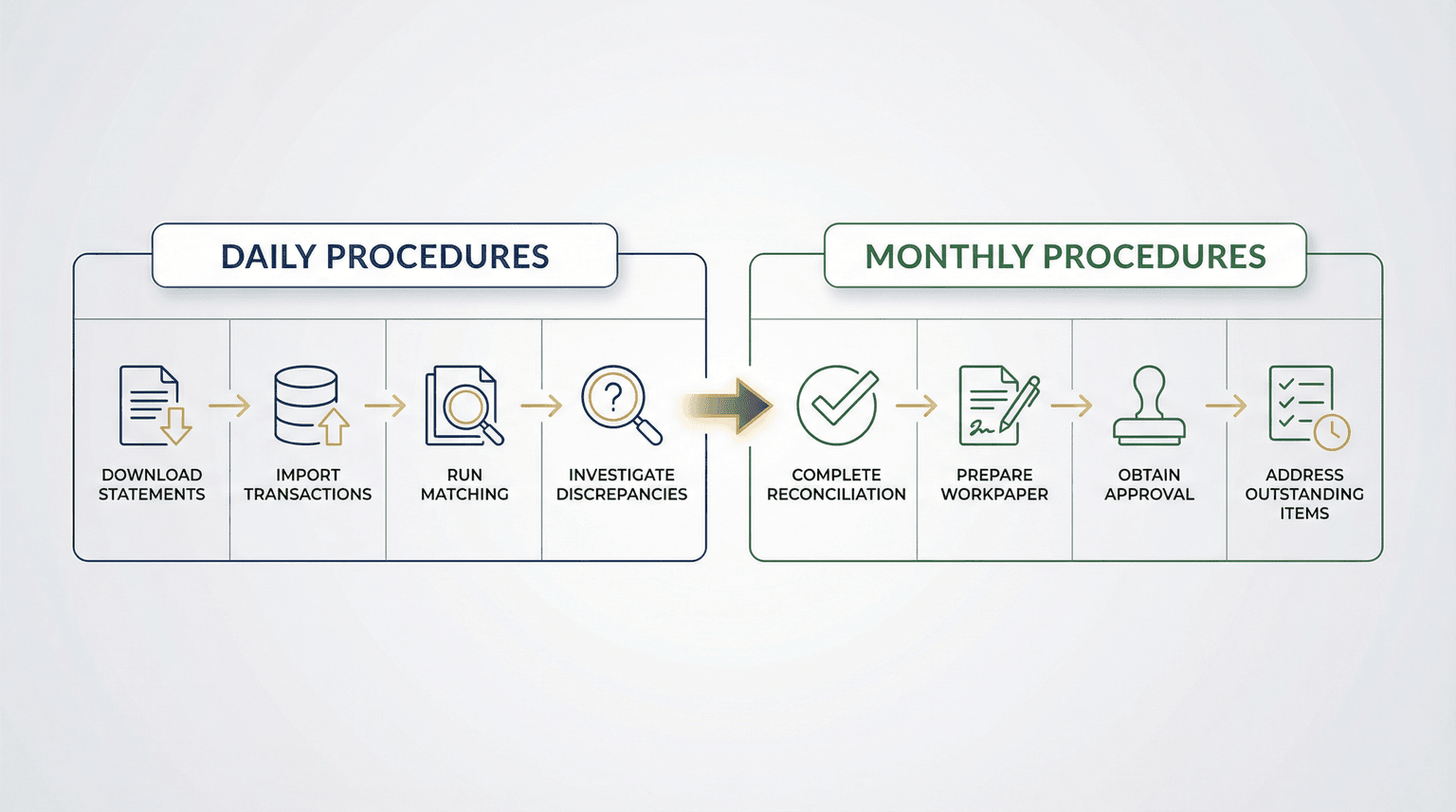
Bank reconciliation is one of the most fundamental financial controls, yet it is frequently cited in audit findings. A comprehensive bank reconciliation SOP should include:
Daily Procedures:
- Download bank statements and transaction files from banking portals
- Import transactions into the accounting system
- Run automated matching against recorded transactions
- Investigate and resolve matching exceptions within 24 hours
- Document reasons for all unmatched items exceeding $1,000
Monthly Procedures:
- Complete full reconciliation within five business days of month-end
- Prepare reconciliation workpaper documenting all outstanding items
- Obtain supervisory review and approval for all reconciliations
- Escalate aged outstanding items (greater than 30 days) to management
- File completed reconciliations in the permanent audit file
Control Requirements:
- Segregation of duties between reconciliation preparer and bank signatories
- Independent review of all reconciliations by personnel not involved in cash handling
- Management approval required for any adjustments exceeding materiality threshold
- Quarterly testing of reconciliation controls by internal audit
Month-End Financial Close SOP Example
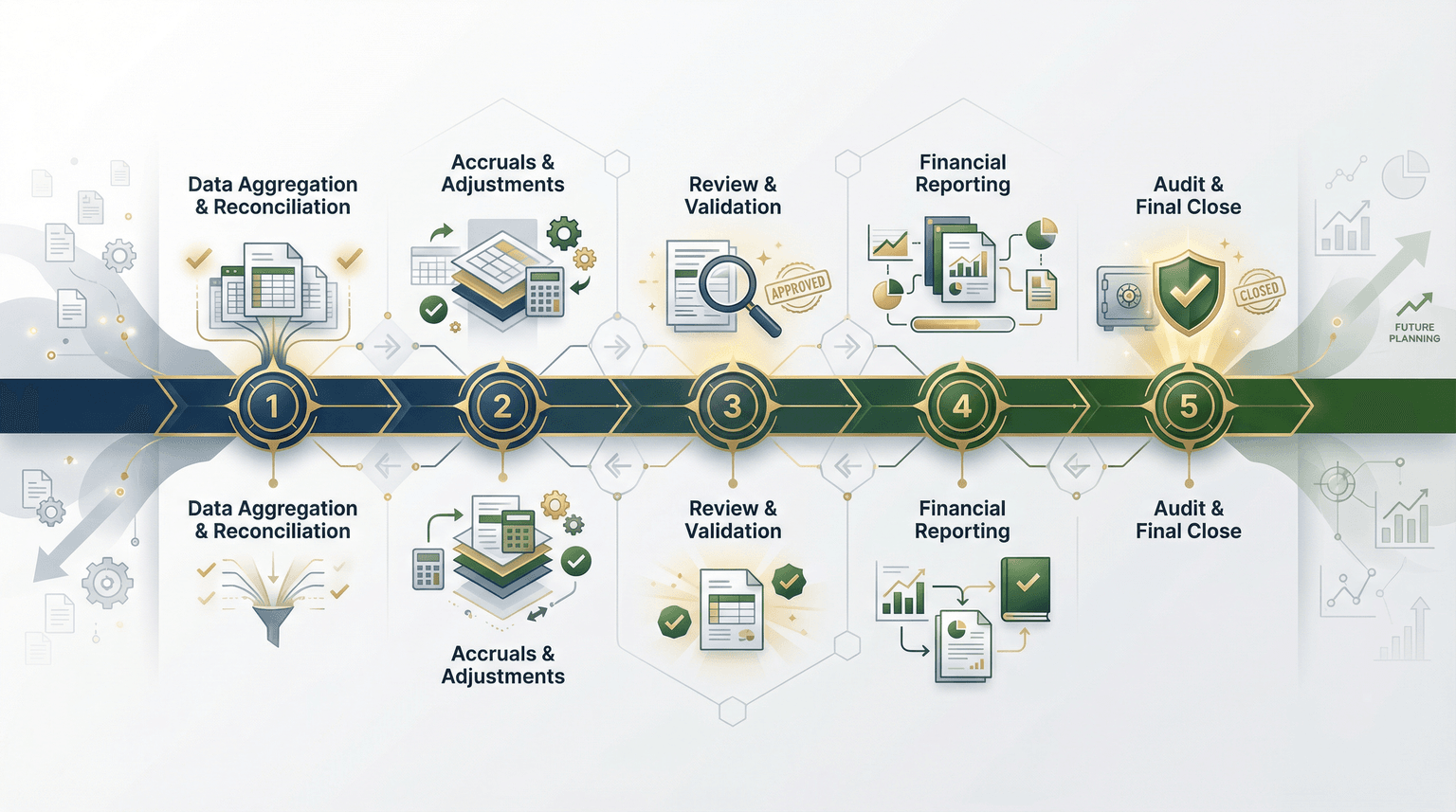
The month-end close process is where financial SOP quality becomes most visible. Organizations with well-documented close procedures consistently outperform peers on close timing and accuracy metrics.
Pre-Close Activities (Days -5 to -1):
- Distribute close calendar with task assignments and deadlines
- Confirm all subsidiary systems are prepared for close
- Complete preliminary review of significant transactions
- Verify intercompany activity is recorded and ready for elimination
- Confirm all recurring journal entries are prepared
Close Activities (Days 1-5):
- Day 1: Close subledgers (AP, AR, Fixed Assets, Payroll)
- Day 2: Complete all manual journal entries and adjustments
- Day 3: Perform analytical review of all significant accounts
- Day 4: Complete management review and approve financial statements
- Day 5: Finalize reporting package and distribute to stakeholders
Post-Close Activities:
- Document any close issues and lessons learned
- Update close procedures based on experience
- Prepare variance analysis and management commentary
- Archive close documentation per retention requirements
Compliance Monitoring SOP Example
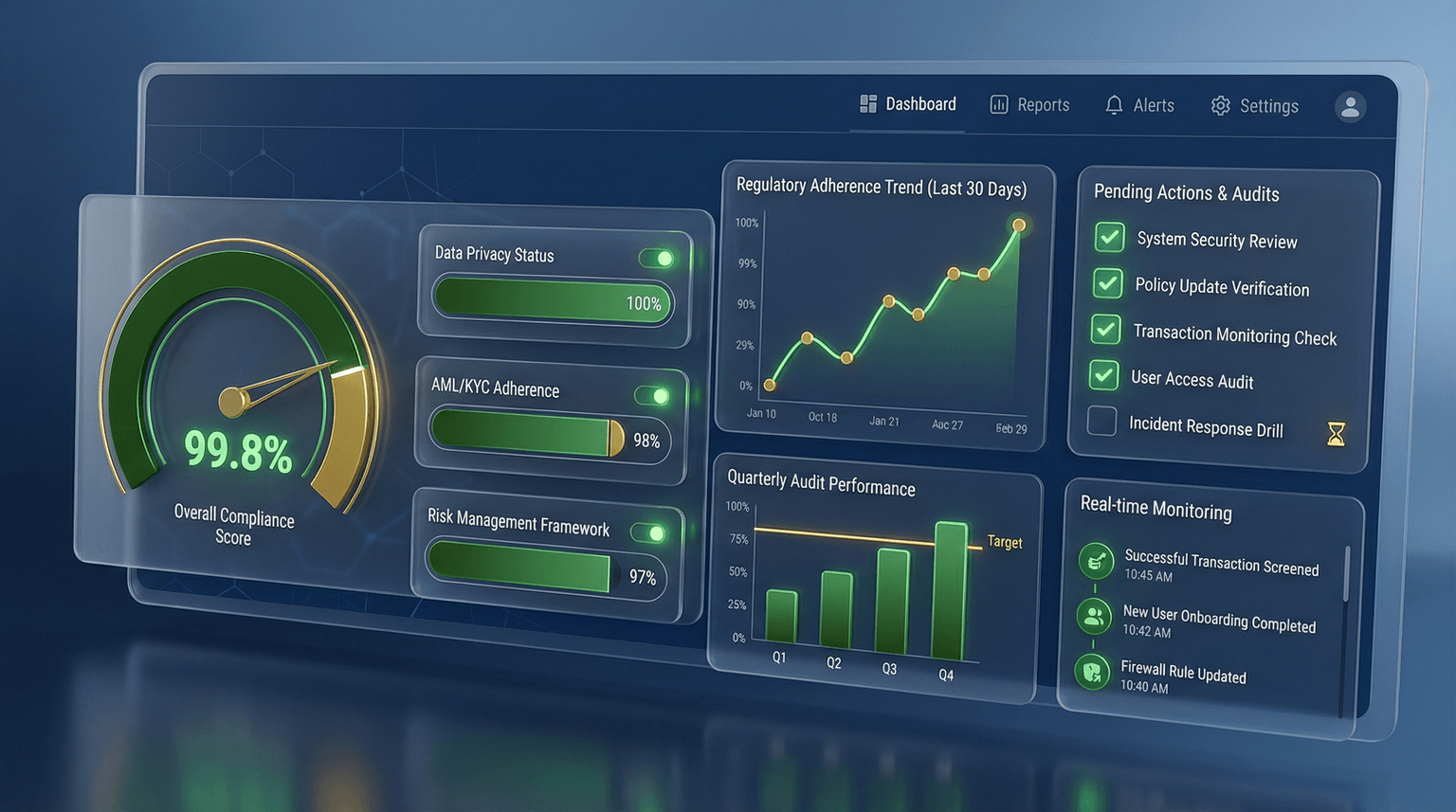
With regulatory examination frequency increasing, organizations need documented procedures for ongoing compliance monitoring:
Weekly Compliance Activities:
- Review regulatory news and alerts for relevant changes
- Monitor compliance dashboards for exception reports
- Follow up on outstanding compliance action items
- Update compliance issue tracker
Monthly Compliance Activities:
- Complete regulatory change assessment and impact analysis
- Review compliance metrics and key risk indicators
- Prepare compliance status report for management
- Test sample of controls per the annual testing plan
Quarterly Compliance Activities:
- Conduct comprehensive compliance self-assessment
- Present compliance report to Audit Committee
- Update risk assessment and compliance priorities
- Review and update compliance policies and procedures
Designing Effective SOPs for Financial Operations
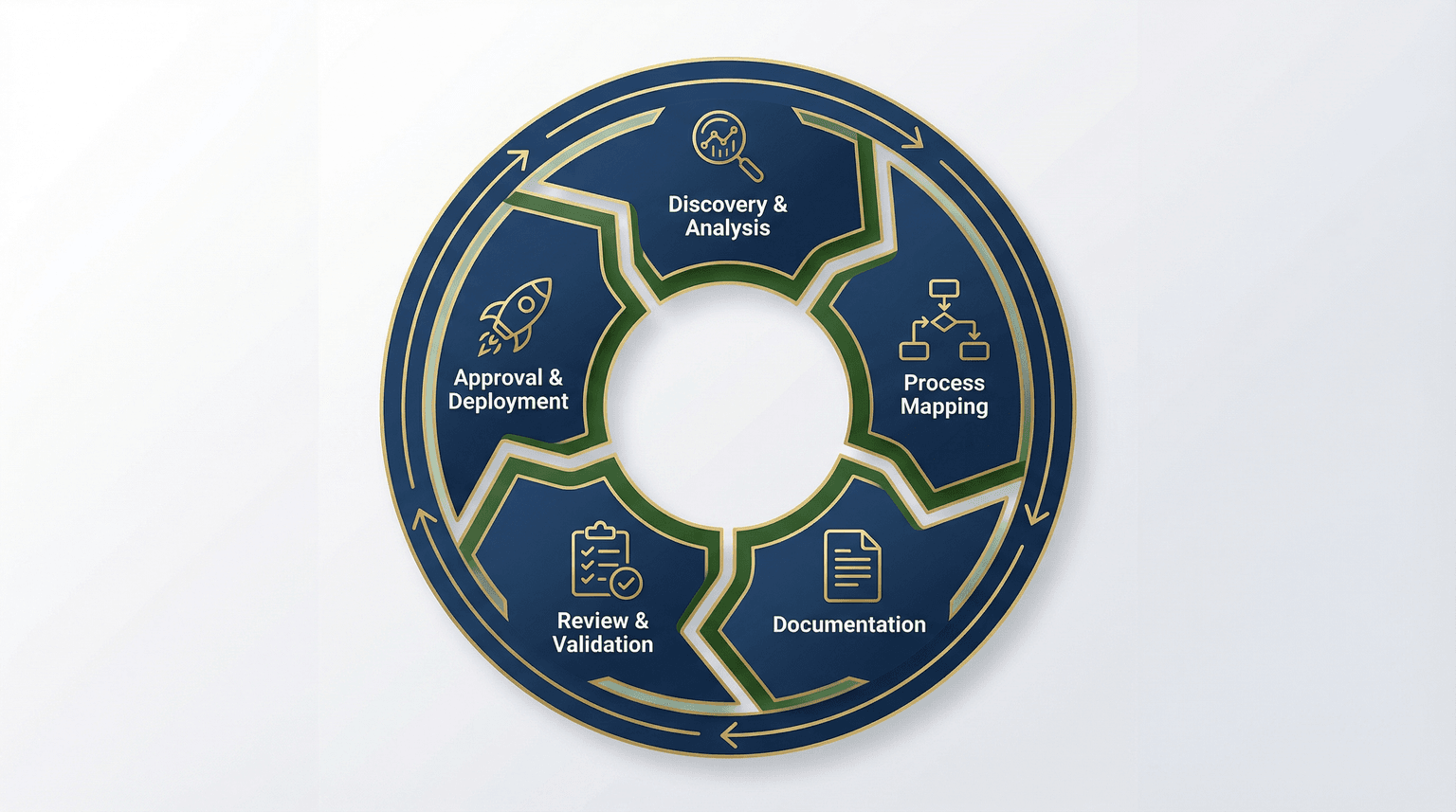
The Five-Phase SOP Development Framework
Creating effective financial SOPs requires a systematic approach that balances thoroughness with practicality. The following five-phase framework ensures comprehensive coverage while maintaining usability:
Phase 1: Discovery and Analysis Begin by understanding the current state of the process. Interview process participants at all levels, from the staff members executing transactions to the managers reviewing results. Document not just what should happen according to existing documentation, but what actually happens in practice. This gap analysis often reveals significant disconnects between documented procedures and operational reality.
Review relevant regulations, accounting standards, and audit findings to identify compliance requirements. Examine historical errors, control failures, and audit adjustments to identify high-risk areas requiring enhanced documentation. This phase typically requires two to four weeks for complex financial processes.
Phase 2: Process Mapping and Optimization Before documenting a process, optimize it. There is little value in creating detailed documentation for an inefficient process. Map the current state process, identify bottlenecks and inefficiencies, and design an improved future state. Consider automation opportunities, unnecessary approvals that add time without adding value, and control gaps that create risk.
Use process mapping tools to visualize the workflow, including decision points, hand-offs between individuals or departments, and integration points with systems. This visual representation becomes the foundation for the written SOP and helps identify control points requiring documentation.
Phase 3: Documentation Development With the process optimized and mapped, begin drafting the SOP. Use clear, action-oriented language that specifies who does what, when, and how. Avoid vague terms like "as needed" or "periodically"---instead, specify precise frequencies and triggers.
Include screen shots, examples, and templates where they add clarity. For complex calculations or judgments, provide detailed guidance and examples covering common scenarios. Build in references to related procedures, policies, and regulatory requirements. For best practices on creating user-friendly documentation, see our ultimate guide to documentation.
Phase 4: Review and Validation Before finalizing, validate the SOP through multiple review cycles. Process participants should confirm that the documented procedure accurately reflects the optimized process. Compliance and legal teams should verify regulatory alignment. Internal audit should assess whether the documented controls are designed effectively. Management should confirm that the procedure aligns with organizational objectives and risk tolerance.
Consider piloting the SOP with a subset of users before full deployment. This pilot period often reveals ambiguities or impracticalities that can be addressed before broad implementation.
Phase 5: Approval and Deployment Obtain formal approval from appropriate levels of management. Document the approval, including the approver, date, and version number. Deploy the SOP through your centralized documentation repository, ensuring all affected personnel have access and are notified of the new or updated procedure.
Common Pitfalls and How to Avoid Them
Over-Documentation: While thoroughness is important, excessively detailed SOPs become unwieldy and are often ignored. Focus on high-risk steps and judgment areas while allowing flexibility for routine activities. A 50-page SOP that no one reads provides less value than a 10-page SOP that is actively used.
Under-Documentation: Conversely, SOPs that provide insufficient detail leave too much to interpretation. When different employees interpret the same procedure differently, inconsistency and errors result. Ensure adequate detail for all critical steps, especially those involving judgment or exceptions.
Static Documentation: Financial processes evolve constantly due to regulatory changes, system updates, and process improvements. SOPs that are not regularly updated become progressively less useful and can even create compliance risk if they reflect outdated requirements. Build in formal review cycles and make updates as part of normal operations.
Inaccessible Documentation: The best SOP is worthless if employees cannot find it when needed. Ensure SOPs are stored in an accessible location, properly indexed, and searchable. Consider the context in which employees will need to reference procedures and optimize for that use case.
Get this SOP handbook as a live site
Your SOP handbook is already live at yourcompany.dewstack.com: written, structured, searchable. Edit it, don't start it.
Start free and get it liveNo credit card. Edit it, don't start it.
Implementation Strategies for Finance Departments
Building a Culture of Compliance
Successful SOP implementation requires more than distributing documents---it requires cultural change. Finance professionals must view SOPs not as bureaucratic overhead but as tools that protect them, their organizations, and their careers.
Executive Sponsorship: Implementation efforts succeed when leadership visibly champions them. When the CFO regularly references SOPs in communications, asks about procedure compliance in meetings, and holds managers accountable for documentation quality, the organization takes notice.
Communication Strategy: Explain the "why" behind SOPs, not just the "what." When employees understand that procedures protect them from personal liability, prevent career-damaging audit findings, and reduce daily frustration, they become willing participants rather than reluctant conscripts.
Integration with Performance Management: Consider documentation compliance in performance evaluations. Recognize individuals who identify procedure improvements. Create incentives for compliance rather than relying solely on consequences for non-compliance.
Training and Knowledge Transfer
Training on new SOPs must go beyond distributing documents and asking employees to acknowledge receipt. Effective training includes:
Initial Training: Conduct formal training sessions when deploying new or significantly revised SOPs. Walk through the procedure step by step, explain the rationale for each requirement, and provide opportunities for questions. Use real examples and scenarios relevant to your organization.
Practical Application: Follow classroom training with supervised practice. Have employees execute the procedure while trainers observe and provide feedback. This hands-on experience builds competence and confidence far more effectively than passive learning.
Ongoing Reinforcement: Schedule periodic refresher training, especially for complex or high-risk procedures. Use actual errors or near-misses as learning opportunities. Keep procedures top of mind through regular communications and reminders.
Knowledge Assessment: Verify that training was effective through testing or observation. Document training completion and assessment results as evidence of control operation.
Monitoring and Continuous Improvement
Implementation does not end with deployment. Ongoing monitoring ensures that SOPs remain effective and identifies opportunities for improvement:
Compliance Monitoring: Regularly assess whether procedures are being followed. Use sampling to test compliance, review exception reports, and investigate deviations. Address non-compliance promptly through coaching, retraining, or, if necessary, disciplinary action.
Effectiveness Monitoring: Track metrics that indicate whether procedures are achieving their objectives. If error rates remain high despite procedure compliance, the procedure itself may need improvement. If processing times exceed targets, look for opportunities to streamline.
Feedback Mechanisms: Create channels for employees to suggest procedure improvements. Those executing procedures daily often have the best insights into inefficiencies and improvement opportunities. Consider regular feedback sessions or suggestion systems.
Regular Review Cycles: Establish formal review schedules for all SOPs. High-risk or rapidly changing procedures may require quarterly review, while stable procedures might be reviewed annually. Document reviews even when no changes result---this evidence is valuable for auditors.
Measuring SOP Effectiveness and ROI
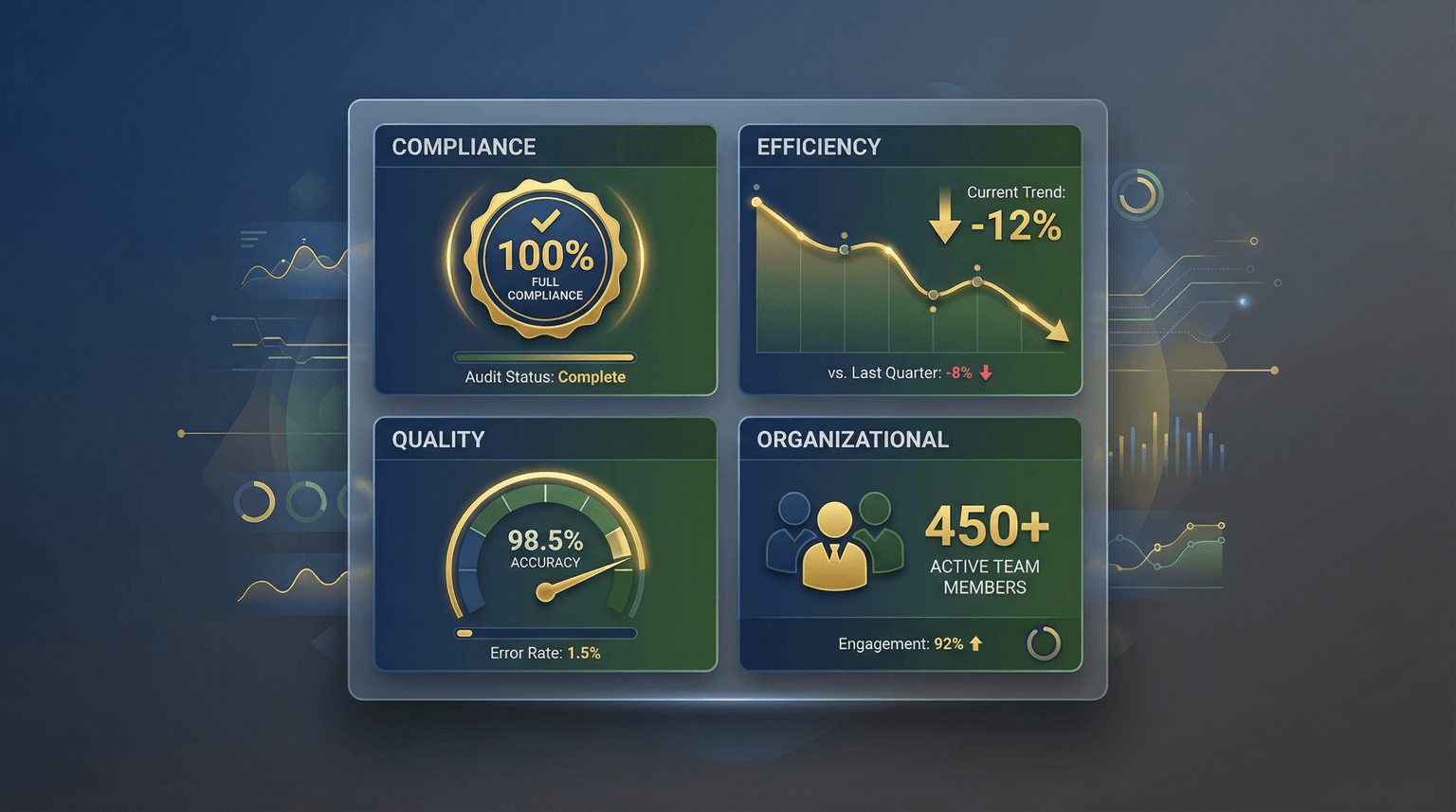
Key Performance Indicators for Financial SOPs
Demonstrating SOP value requires measuring the right metrics. Consider these KPIs for your financial documentation program:
Compliance Metrics:
- Percentage of procedures with current documentation (target: 100%)
- Percentage of employees trained on applicable procedures (target: 100%)
- Number of compliance violations related to procedural failures (target: zero)
- Audit findings related to documentation deficiencies (target: zero)
Efficiency Metrics:
- Time to complete key processes (compare to pre-SOP baseline)
- Error rates in financial processing (target: continuous reduction)
- Rework percentage (transactions requiring correction)
- Month-end close duration (industry benchmark: 5-7 days)
Quality Metrics:
- Number of post-close adjustments
- Financial statement accuracy (restatement frequency)
- Auditor-proposed adjustments (quantity and dollar value)
- Internal audit finding severity
Organizational Metrics:
- New employee time to productivity
- Finance staff turnover rate
- Employee satisfaction with procedures and tools
- Cross-training coverage for critical functions
Calculating Documentation ROI
While some SOP benefits are intangible, many can be quantified to demonstrate return on investment:
Error Reduction Value: Calculate the cost of errors (investigation time, correction time, customer impact, regulatory penalties) and multiply by the reduction rate attributable to improved SOPs.
Efficiency Gains: Measure time savings from standardized procedures and multiply by loaded labor costs. A 10% efficiency improvement in a 50-person finance department represents substantial annual savings.
Audit Cost Reduction: Track audit hours related to documentation requests and control testing. Organizations with mature documentation consistently report 20-30% reductions in audit effort and corresponding fee reductions.
Risk Mitigation Value: While difficult to quantify precisely, reduced regulatory risk has real value. Consider the cost of potential enforcement actions, remediation efforts, and reputational damage that improved SOPs help avoid.
Technology and the Future of Financial SOPs
Digital Transformation of Documentation
The era of SOPs as static Word documents stored on network drives is ending. Modern SOP creation software transforms documentation from a compliance burden into a strategic asset:
Real-Time Documentation: Browser-based capture tools allow procedures to be documented as they are executed, ensuring accuracy and reducing documentation effort by up to 50%.
AI-Powered Assistance: Artificial intelligence helps draft SOP content, answers employee questions about procedures, and identifies inconsistencies or gaps in documentation.
Version Control and Audit Trails: Digital platforms automatically track changes, maintain version history, and create audit trails that satisfy the most demanding regulatory requirements.
Analytics and Insights: Modern platforms provide visibility into documentation usage, identifying which procedures are frequently accessed (and therefore critical) and which are neglected (and perhaps obsolete).
Emerging Trends in Financial SOPs
Integration with Workflow Systems: SOPs are increasingly embedded directly into the systems where work happens. Rather than referencing a separate document, employees see procedural guidance within their workflow tools.
Continuous Compliance Monitoring: Advanced organizations are moving from periodic compliance testing to continuous monitoring, with automated systems verifying that procedures are followed in real time.
Adaptive Procedures: Machine learning enables procedures that adapt based on context. A reconciliation procedure might provide different guidance based on the account type, dollar amount, or user experience level.
Collaborative Development: Cloud-based platforms enable distributed teams to collaborate on procedure development, with subject matter experts contributing regardless of location.
Mobile Accessibility: As finance work becomes increasingly mobile, SOPs must be accessible on any device. Mobile-optimized documentation ensures that procedures are available whenever and wherever they are needed.
Frequently Asked Questions
What are Standard Operating Procedures (SOPs) in the financial context?
SOPs in finance are documented guidelines that outline step-by-step processes and best practices to be followed in various financial activities. These procedures help maintain consistency, reduce errors, and ensure regulatory compliance for activities like accounts payable/receivable, financial reporting, budgeting, and auditing. In the regulatory context, financial SOPs also serve as evidence of internal controls for SOX compliance and audit purposes.
Why are SOPs important for financial organizations?
SOPs are crucial because they ensure tasks are executed efficiently and in compliance with regulations. They provide a standardized framework maintaining consistency, accuracy, and transparency in financial processes, reducing error risks and ensuring smooth financial activity execution. Beyond operational benefits, SOPs protect organizations from regulatory penalties, support audit readiness, and reduce the risk associated with employee turnover by preserving institutional knowledge.
What are the key components of an effective financial SOP?
An effective financial SOP includes: objective definition, scope specification, step-by-step procedures, roles and responsibilities, quality control measures, documentation requirements, and a review and update schedule to maintain relevance with regulatory changes. Additionally, financial SOPs should include control points that satisfy audit requirements, exception handling procedures, and clear escalation paths for issues requiring management attention.
How are SOPs developed and implemented in finance departments?
Development involves gathering information about current procedures, regulations, and best practices; mapping processes step-by-step; identifying risks and defining controls; documenting the SOP clearly; and obtaining stakeholder approval. Implementation requires comprehensive training, clear communication channels, regular audits, and a centralized SOP repository. Successful implementation also requires executive sponsorship, change management planning, and ongoing monitoring to ensure sustained compliance.
What future trends are influencing SOPs in finance?
Emerging trends include automation and artificial intelligence streamlining processes, blockchain technology offering enhanced security and transparency, continuous improvement through regular SOP reviews, risk-based approaches proactively addressing potential risks, and agile SOP development allowing rapid adaptation to changing market conditions. Additionally, integration of SOPs with workflow systems, real-time documentation capture, and mobile accessibility are reshaping how financial organizations approach procedural documentation.
Build Better Financial SOPs with Dewstack
In an industry where compliance and precision are non-negotiable, your SOPs need a platform that matches your standards. Dewstack provides financial institutions with the tools to create, maintain, and distribute SOPs that keep teams audit-ready and operations running smoothly.
Document processes as they happen: With Dewstack's browser extension, your compliance team can capture procedures in real-time---screenshots, annotations, and step-by-step workflows---without interrupting their work. Perfect for documenting complex financial processes accurately.
AI-powered compliance assistance: Dewstack's SmartDocs feature uses AI to help draft clear, compliant SOP content and instantly answer employee questions about procedures. Reduce training time and ensure consistent adherence to protocols across your organization.
Centralize scattered documentation: Import existing SOPs from Word, PDFs, Confluence, or legacy systems into one secure, searchable platform. Version control ensures everyone accesses the current approved procedures while maintaining full audit trails.
Enterprise-grade security and customization: Host your financial SOPs on custom domains with your branding. Role-based access controls, SSO integration, and detailed analytics give you complete visibility into who's accessing what---critical for regulatory compliance.
Ready to bring your financial SOPs into the modern era? Try Dewstack for free and experience intelligent documentation that meets the demands of today's financial landscape. Plans scale from small teams to enterprise — see pricing for details.
Ready to Elevate Your Documentation?
Try Dewstack free for 7 days. Create AI-powered documentation that answers questions instantly.
Start a free trialANSWERS TO
Frequently Asked Questions
Here are some common questions that might provide the information you're seeking.
Related Blogs
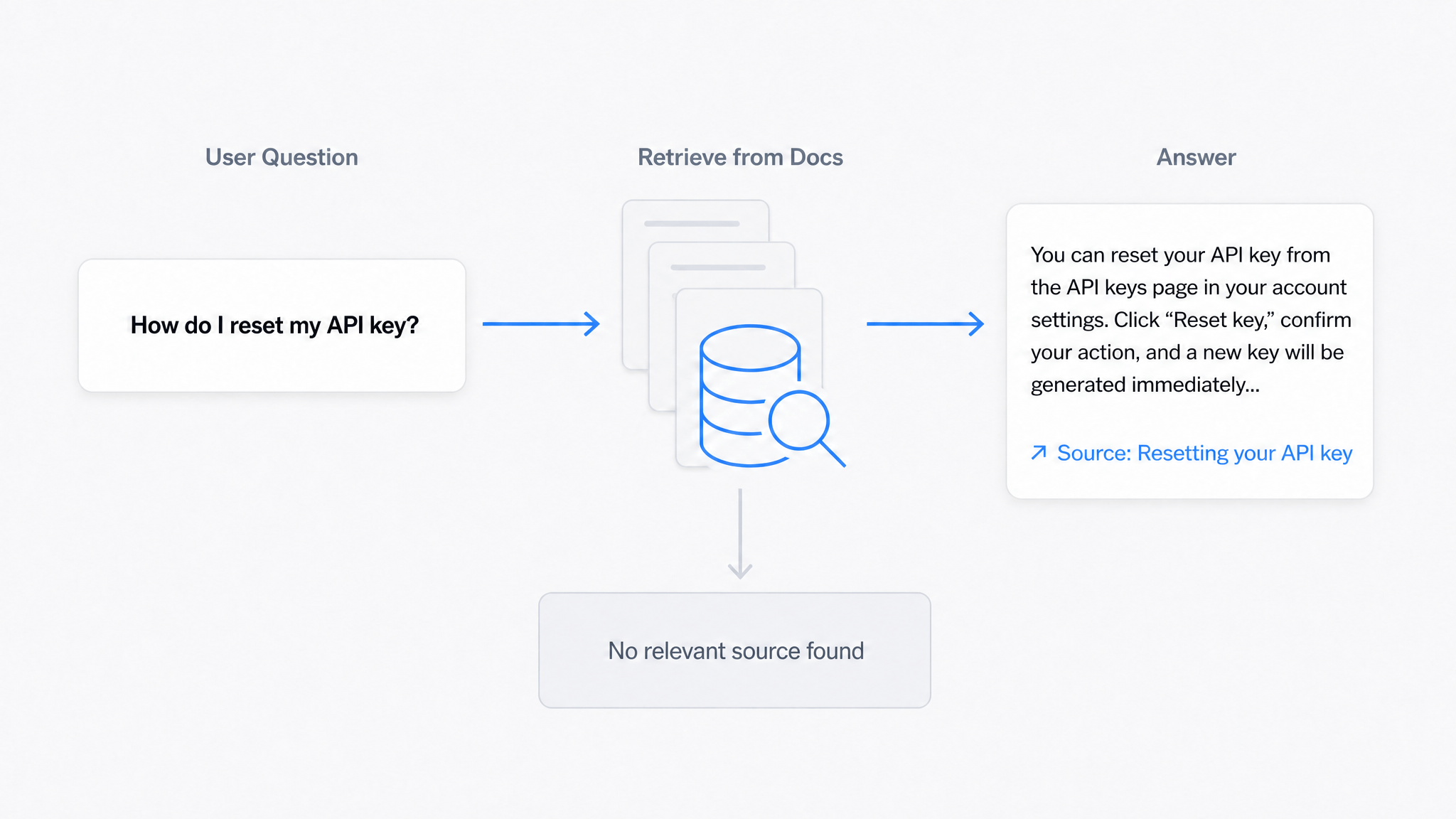
AI Answers From Your Docs: Grounded Answers, Citations & Hallucination Control
How an AI chatbot for technical documentation gives grounded answers with source citations, controls hallucinations, and turns unanswered questions into drafted pages.
How to Use AI to Improve Existing Documentation
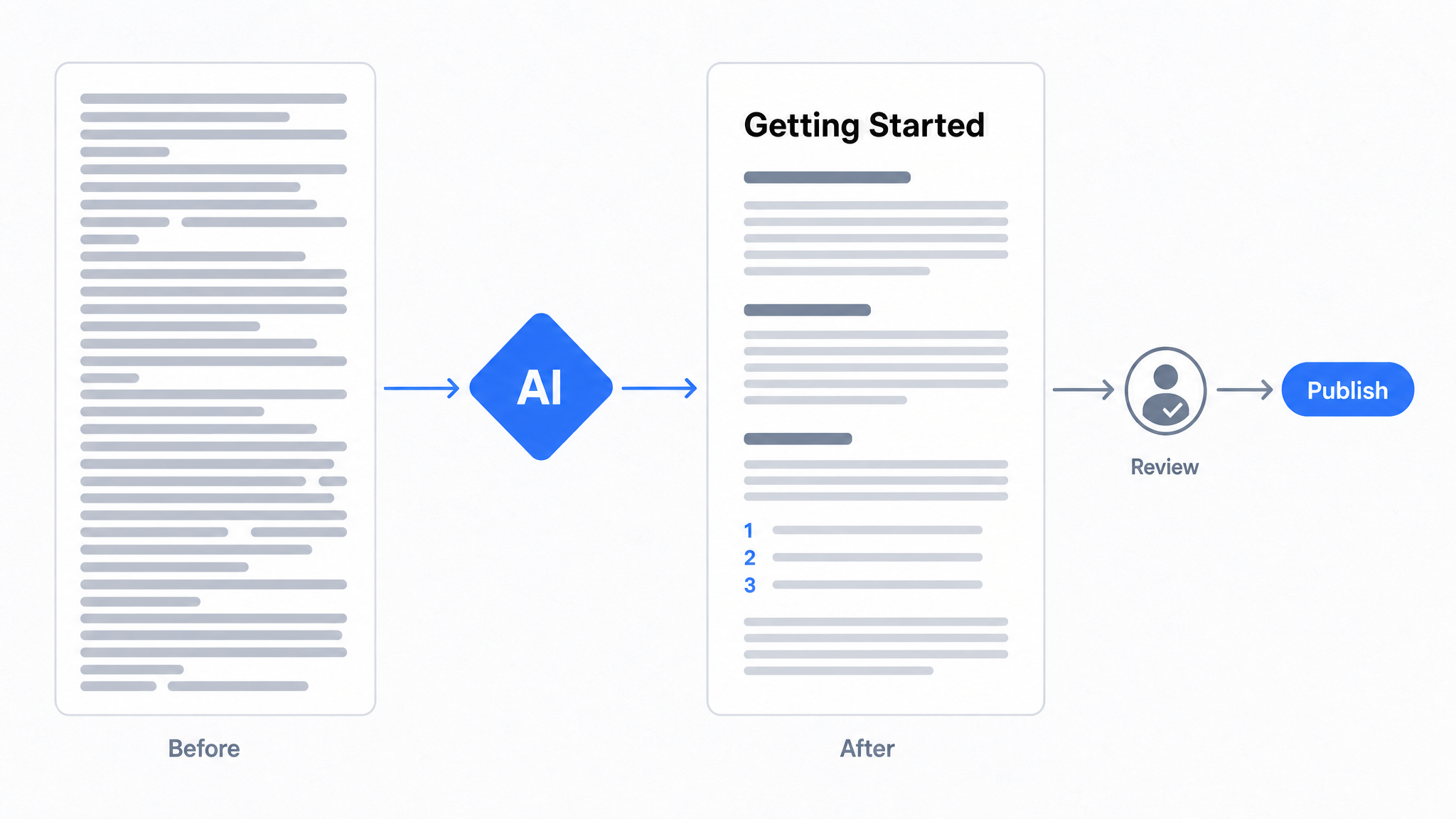
Use AI to audit, rewrite, and translate the documentation you already have, and let a connected agent draft improvements to stale pages for a human to publish.
How to Automate SOP Creation with AI
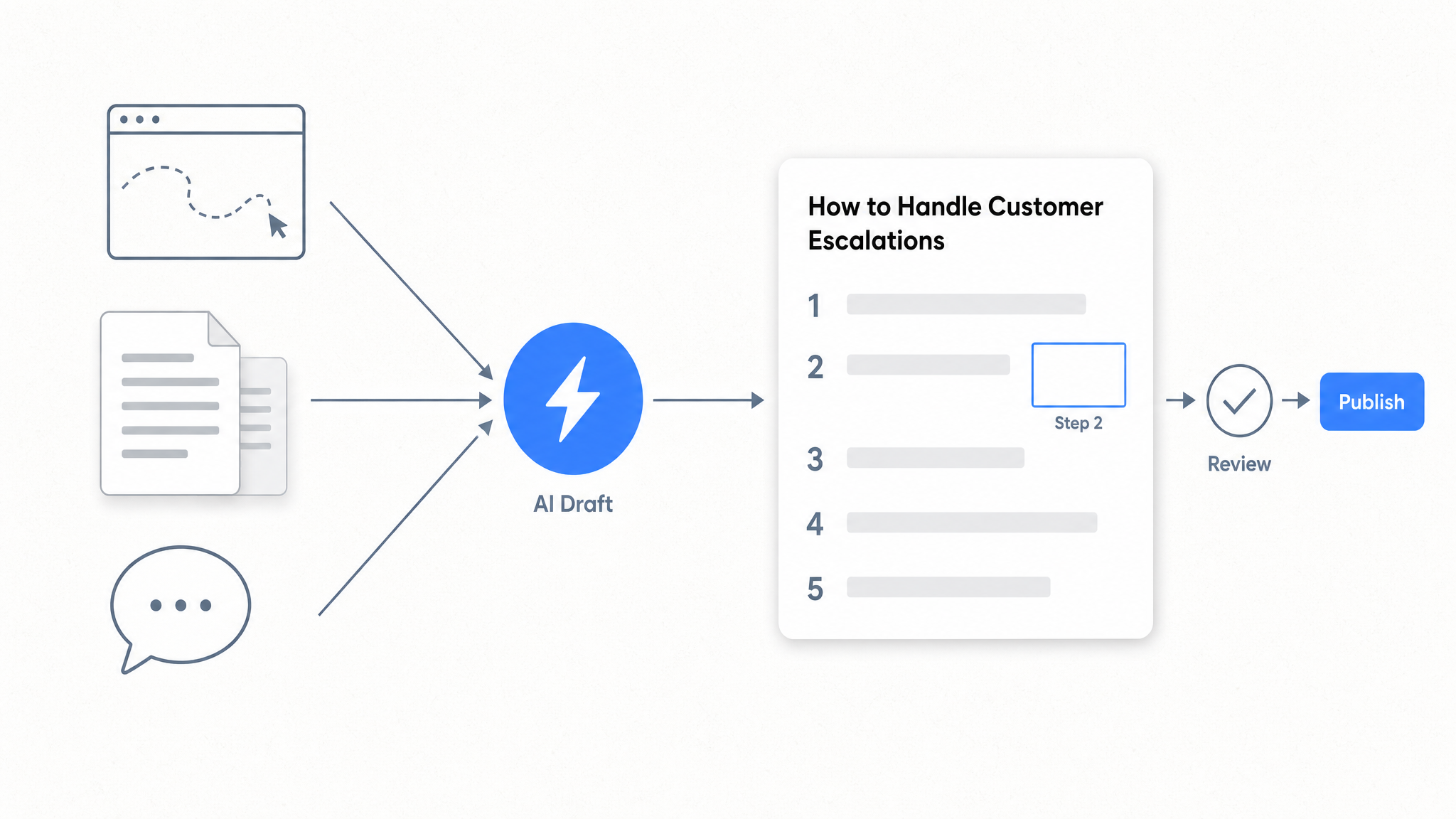
Capture a workflow, let AI draft the SOP, review it, and publish it to a searchable knowledge base your team can query around the clock.
Ready to get started with Dewstack?
Try Dewstack free for 7 days. Create AI-powered documentation that answers questions instantly.
No credit card required.