The Power of Knowledge: Why User Documentation and Guides are Essential for Your Business


The Power of Knowledge: Why User Documentation and Guides are Essential for Your Business
When Slack first launched, they faced a challenge every growing software company knows well: support tickets were piling up, response times were suffering, and their support team was struggling to keep pace with user questions. Their solution was not to hire an army of support agents but to invest heavily in comprehensive self-service documentation. The result was transformative, with support ticket volume dropping significantly while customer satisfaction scores climbed. This story illustrates a fundamental truth in modern business: documentation is not a cost center but a strategic asset that directly impacts your bottom line.
In an era where 67% of customers prefer self-service over speaking to a representative (Zendesk Customer Experience Trends Report), the businesses that win are those that empower their users with the knowledge they need, precisely when they need it. This comprehensive guide explores why user documentation has evolved from a nice-to-have afterthought into a critical business function that affects everything from customer acquisition to long-term retention.
The True Cost of Poor Documentation
Many businesses underestimate the true cost of inadequate documentation, viewing it as merely an inconvenience rather than a significant financial drain. The reality is far more sobering. Poor documentation creates a cascading effect of problems that touch every part of your organization and customer relationships.
Hidden Financial Impact
Consider what happens when a customer cannot find the answer they need. They either contact your support team, increasing operational costs, or they give up entirely and potentially abandon your product. According to research from Forrester, 89% of consumers have switched to a competitor following a poor customer experience. Documentation gaps are often the first domino in this chain of events.
The financial mathematics become clear when you examine the numbers:
- Direct support costs: Each phone support interaction costs businesses an average of $15 or more, while email support runs $5-10 per ticket. In contrast, a knowledge base interaction costs just $1-2.
- Lost productivity: Employees searching for information they cannot find waste an estimated 20-30% of their workday. For a company with 100 employees earning an average of $50,000 annually, that represents $1-1.5 million in lost productivity each year.
- Customer churn: Customers who struggle with your product due to poor documentation are significantly more likely to cancel their subscriptions or seek alternatives.
- Extended sales cycles: Prospects researching your product often review documentation quality before making purchasing decisions. Incomplete or confusing documentation can kill deals before they even reach your sales team.
The Ripple Effect on Brand Reputation
Beyond the immediate financial impact, poor documentation damages your brand in ways that are difficult to quantify but impossible to ignore. In the age of online reviews and social media, frustrated customers share their experiences widely. A single viral complaint about confusing documentation can reach thousands of potential customers, creating a perception problem that takes months or years to overcome.
Your documentation is often the first substantive interaction a customer has with your company after purchase. When that interaction is frustrating, it colors every subsequent touchpoint. Conversely, clear, helpful documentation establishes trust and confidence that carries forward into the entire customer relationship.
There's a ready-made version of this
Your user manual is already live at yourcompany.dewstack.com, with getting started, features, troubleshooting and glossary all written. Edit it, don't start it.
Preview itNo credit card. Edit it, don't start it.
How Documentation Reduces Support Costs
The connection between quality documentation and reduced support costs is not merely theoretical. Organizations that invest in comprehensive knowledge bases and user guides consistently report dramatic reductions in support ticket volume and associated costs.
The Numbers Tell the Story
Research consistently shows that good documentation reduces support tickets by 30-50%. For a company handling 10,000 support tickets monthly at an average cost of $10 per ticket, this represents potential savings of $30,000-50,000 per month, or $360,000-600,000 annually.
These savings compound over time. As your documentation library grows and improves, the deflection rate increases. Moreover, the tickets that do reach your support team become more complex and valuable, as simple questions are handled through self-service. This allows your support staff to focus on building relationships and solving problems that genuinely require human intervention.
The Cost Comparison
| Support Channel | Cost Per Interaction | Customer Satisfaction |
|---|---|---|
| Phone Support | $15-35 | Varies by wait time |
| Email Support | $5-10 | Moderate |
| Live Chat | $3-8 | High when staffed |
| Knowledge Base | $1-2 | High when effective |
| AI-Powered Docs | $0.50-1 | Very high with good content |
The economics are compelling. Every successful self-service interaction represents not just a cost saving but an improvement in customer experience. Customers who find answers quickly report higher satisfaction than those who had to wait for support responses, even when the support interaction was positive.
Scaling Without Proportional Cost Increases
Perhaps the most significant benefit of documentation investment is the ability to scale your customer base without proportionally scaling your support team. Traditional support models require adding headcount as your customer base grows. With effective self-service documentation, you can support significantly more customers per support agent, fundamentally changing the economics of growth.
This scalability becomes crucial during periods of rapid growth, seasonal spikes, or product launches when support volume can surge dramatically. Well-prepared documentation absorbs these spikes without requiring expensive temporary staffing or forcing existing teams into overtime.
For more insights on creating documentation that scales, explore our guide on how to create documentation that users actually read.
Impact on Customer Onboarding and Retention
The customer journey does not end at purchase; it begins there. Onboarding represents a critical window where customers form lasting impressions about your product and their decision to buy it. Documentation plays a central role in determining whether that impression is positive or negative.
Accelerating Time to Value
The concept of "time to value" measures how quickly customers can achieve meaningful results with your product. Shorter time to value correlates strongly with higher retention rates, increased expansion revenue, and more positive word-of-mouth referrals.
Effective documentation dramatically reduces time to value by:
- Eliminating confusion: Clear getting-started guides remove the friction that causes customers to abandon products during initial setup.
- Preventing early mistakes: Documentation that anticipates common pitfalls helps customers avoid frustrating errors that can derail their experience.
- Enabling self-paced learning: Not every customer wants to schedule training calls or attend webinars. Documentation allows customers to learn at their own pace, on their own schedule.
- Supporting different learning styles: Some customers prefer written instructions, others prefer video tutorials, and still others learn best from examples. Comprehensive documentation accommodates all preferences.
Get this user manual as a live site
Your user manual is already live at yourcompany.dewstack.com, with getting started, features, troubleshooting and glossary all written. Edit it, don't start it.
Start free and get it liveNo credit card. Edit it, don't start it.
The Retention Connection
Customer retention is the lifeblood of sustainable business growth. Acquiring a new customer costs 5-25 times more than retaining an existing one, making retention improvements extraordinarily valuable. Documentation directly impacts retention in several ways:
Problem resolution: When customers encounter issues, their ability to quickly find solutions determines whether they view your product as reliable or frustrating. Self-service documentation that addresses common problems keeps small issues from becoming cancellation triggers.
Feature discovery: Many customers churn not because they are dissatisfied but because they never discovered the features that would make your product indispensable. Documentation that highlights capabilities and use cases helps customers extract maximum value.
Confidence building: Customers who understand how to use your product feel more confident and more committed. That confidence translates into willingness to expand usage, recommend your product to others, and remain loyal through occasional difficulties.
Learn more about optimizing the customer journey in our article on building effective knowledge bases for customer success.
Documentation as a Competitive Advantage
In crowded markets where features increasingly converge, documentation quality can be a decisive differentiator. Smart companies recognize this and treat their documentation as a strategic asset rather than a necessary evil.
Standing Out in Feature-Equal Markets
When competing products offer similar functionality at similar price points, customers look beyond features to make decisions. They evaluate:
- Ease of implementation: Can they get up and running quickly? Documentation quality directly determines this.
- Ongoing support: Will they have the resources they need to succeed long-term? Comprehensive documentation signals commitment to customer success.
- Professional image: Quality documentation reflects attention to detail and customer focus that extends throughout the organization.
Companies like Stripe, Twilio, and Notion have built legendary reputations partly on the strength of their documentation. Developers and business users alike cite documentation quality as a primary reason for choosing these platforms over competitors.
The Developer Experience Factor
For technical products, documentation often determines developer adoption entirely. Developers evaluate products by diving into the documentation before anything else. If they cannot understand your API, SDK, or platform from your docs, they move on to competitors who make learning easier.
This effect extends beyond initial adoption. Developers who find excellent documentation become advocates, recommending your product in forums, blog posts, and workplace conversations. Poor documentation creates the opposite effect, with frustrated developers warning others away.
Documentation as Marketing
Quality documentation serves marketing functions that paid advertising cannot replicate:
- SEO value: Well-structured documentation content ranks for long-tail keywords that bring highly qualified traffic. Customers searching for solutions to specific problems often find documentation that introduces them to your product.
- Trust building: Detailed, transparent documentation demonstrates expertise and builds confidence that generic marketing copy cannot achieve.
- Reduced sales friction: Prospects who can answer their own questions through documentation move through the sales funnel faster with less hand-holding required.
Discover how to leverage documentation for growth in our guide on documentation-driven marketing strategies.
The Self-Service Era: Meeting Modern Customer Expectations

Customer expectations have fundamentally shifted. Today's customers do not want to call support lines or wait for email responses. They want answers immediately, on their terms, through channels they control.
The Self-Service Preference
The statistics paint a clear picture: 67% of customers prefer self-service over speaking to a representative (Zendesk). This preference crosses demographics and industries. Whether your customers are consumers, small business owners, or enterprise IT managers, the majority would rather find answers themselves than interact with support staff.
This preference is not about avoiding human contact; it is about convenience and control. Self-service options allow customers to:
- Get help outside business hours
- Solve problems without waiting
- Learn at their own pace
- Avoid explaining their situation to multiple people
- Feel empowered rather than dependent
The Always-On Expectation
Modern customers expect help to be available 24/7/365. They do not accept that questions that arise at 10 PM on Saturday must wait until Monday morning. Documentation provides the always-on support that meets these expectations without requiring round-the-clock staffing.
This is particularly crucial for global businesses serving customers across time zones. What is 2 AM for your support team might be prime business hours for customers on the other side of the world. Documentation ensures these customers receive the same quality support as those in your home market.
Mobile-First Access
Customers increasingly access support resources from mobile devices. They need help while using your product in the field, during commutes, or in settings where calling support is impractical. Mobile-optimized documentation meets customers where they are, providing seamless access regardless of device or context.
Building a Documentation Strategy That Works
Understanding the importance of documentation is the first step. Executing a documentation strategy that delivers results requires systematic thinking and sustained commitment.
Start with Customer Needs
Effective documentation begins with understanding what your customers actually need to know, not what you want to tell them. Mining support tickets, analyzing search queries, conducting user interviews, and observing onboarding sessions all provide insights into real customer questions and pain points.
Prioritize documentation that addresses:
- High-volume questions: Issues that generate the most support contacts should be documented first.
- High-impact problems: Issues that cause customer churn or prevent adoption deserve priority even if less frequent.
- Complex processes: Multi-step procedures that confuse customers benefit enormously from clear documentation.
- Common mistakes: Problems that customers create themselves through misunderstanding or error can be prevented with proactive documentation.
Structure for Discoverability
Documentation that exists but cannot be found serves no one. Effective documentation architecture ensures customers can locate relevant content quickly:
- Clear navigation: Logical categorization that matches how customers think about problems.
- Powerful search: Search functionality that handles synonyms, typos, and natural language queries.
- Contextual linking: Related articles suggested based on what the customer is viewing.
- Multiple entry points: Content accessible through search, browse, in-app help, and external search engines.
Maintain and Improve Continuously
Documentation is never "done." Products evolve, customer needs change, and content grows stale. Sustainable documentation programs include:
- Regular review cycles: Scheduled audits to identify outdated or inaccurate content.
- Feedback mechanisms: Easy ways for customers to report problems or suggest improvements.
- Analytics tracking: Metrics that reveal which content is valuable and which is not performing.
- Ownership assignment: Clear responsibility for maintaining each content area.
For a deeper dive into documentation maintenance, read our comprehensive guide on keeping your knowledge base fresh and relevant.
Leverage Technology
Modern documentation platforms offer capabilities that make creating and maintaining quality documentation dramatically easier:
- AI-powered assistance: Tools that help generate, improve, and translate documentation content.
- Browser extensions: Capture screenshots, record processes, and create guides in real-time while working.
- Version control: Track changes, manage multiple versions, and roll back mistakes.
- Analytics dashboards: Understand how customers use documentation and identify improvement opportunities.
- Integration capabilities: Connect documentation to support systems, CRM, and product interfaces for seamless customer experiences.
Key Takeaways
Before you go, here are the essential points to remember:
The Business Case is Clear
- 67% of customers prefer self-service over speaking to support representatives
- Good documentation reduces support tickets by 30-50%
- Knowledge base interactions cost $1-2 versus $15+ for phone support
- 89% of consumers have switched to competitors due to poor service experiences
Documentation Drives Multiple Business Outcomes
- Reduced support costs and improved scalability
- Faster customer onboarding and shorter time to value
- Higher retention rates and reduced churn
- Competitive differentiation in crowded markets
- Improved SEO and organic customer acquisition
Success Requires Strategy
- Start with customer needs, not internal assumptions
- Structure content for discoverability and multiple access patterns
- Commit to continuous maintenance and improvement
- Leverage modern technology to scale documentation efforts
The Modern Customer Expects Self-Service
- 24/7 access to help and information
- Mobile-optimized content delivery
- Quick answers without waiting or explaining
- Empowerment and control over their own experience
Build Your Knowledge Arsenal with Dewstack
Ready to harness the power of documentation for your business? Dewstack provides the complete platform for creating, managing, and hosting user guides, knowledge bases, and documentation that drives results.
Capture expertise on the fly: Dewstack's browser extension lets your team document processes and create guides in real-time, complete with screenshots and annotations. Build your knowledge library naturally, without dedicated documentation sprints.
AI that works 24/7: SmartDocs transforms your documentation into an intelligent knowledge engine. Users get instant, contextual answers while your organization scales its expertise infinitely, turning documentation into a true competitive advantage.
Unify scattered content: Import existing guides from any platform, including Word, Google Docs, Confluence, and PDFs, into one organized, searchable hub. Version control ensures everyone accesses the current information.
Measure and improve: Analytics reveal how users engage with your documentation, helping you identify gaps and continuously improve. Custom domains and branding create a seamless experience that reinforces your brand.
Ready to unlock the power of documentation? Try Dewstack for free and see how intelligent documentation can transform your business.
Sources: Zendesk Customer Experience Trends Report, Forrester Research, HDI Support Center Benchmark Report, Harvard Business Review
Ready to Elevate Your Documentation?
Try Dewstack free for 7 days. Create AI-powered documentation that answers questions instantly.
Start a free trialANSWERS TO
Frequently Asked Questions
Here are some common questions that might provide the information you're seeking.
Related Blogs
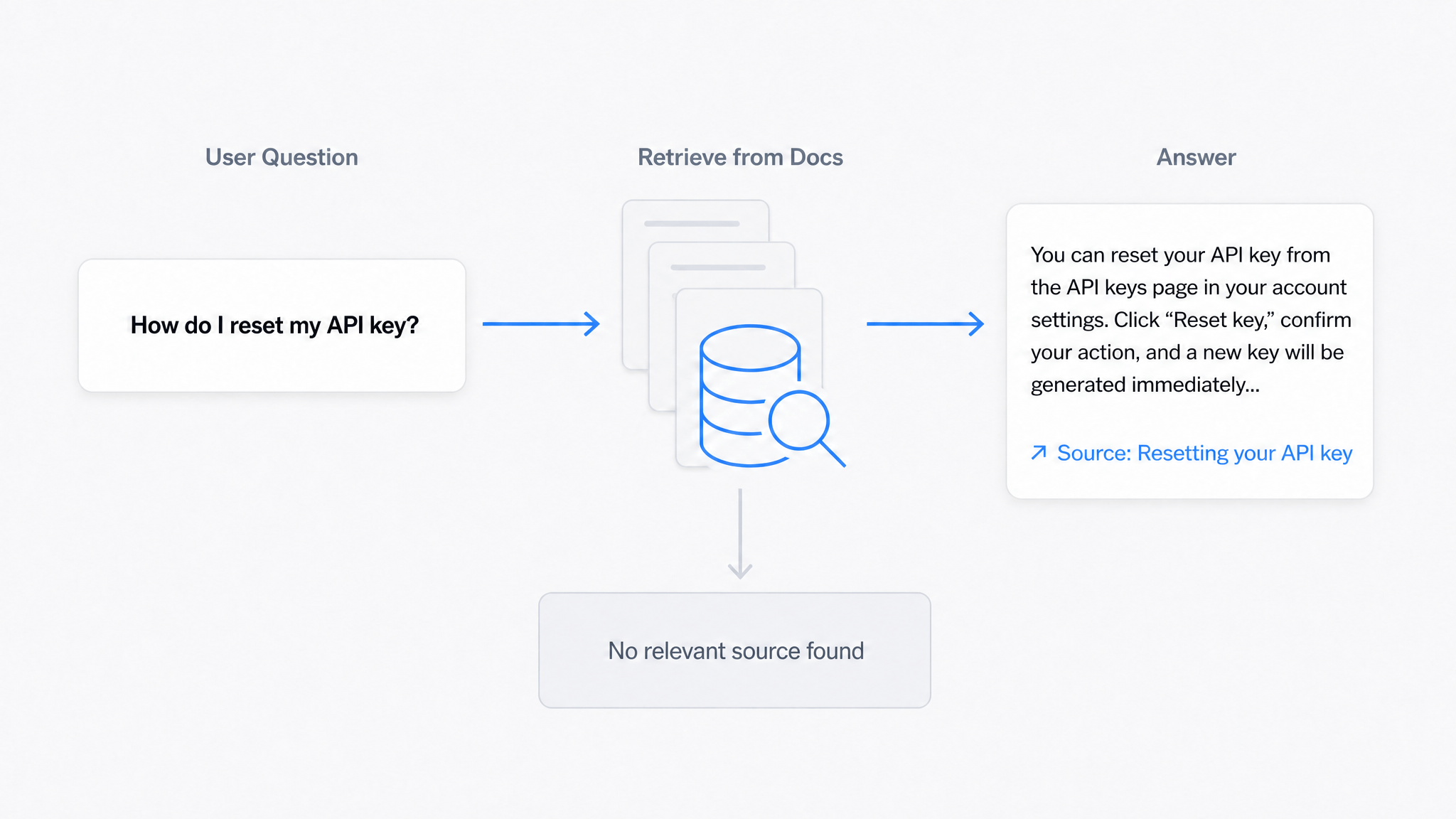
AI Answers From Your Docs: Grounded Answers, Citations & Hallucination Control
How an AI chatbot for technical documentation gives grounded answers with source citations, controls hallucinations, and turns unanswered questions into drafted pages.
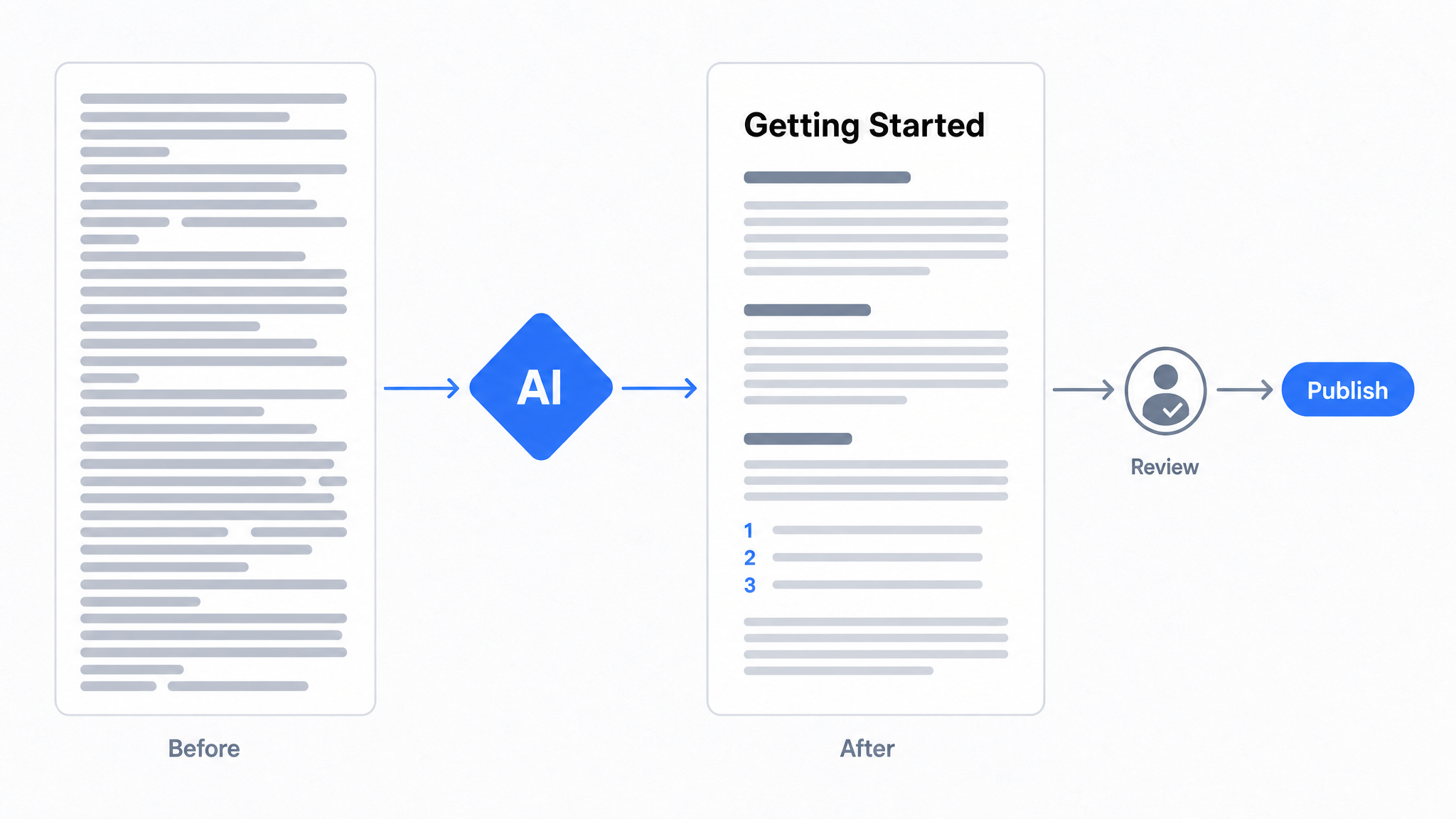
How to Use AI to Improve Existing Documentation
Use AI to audit, rewrite, and translate the documentation you already have, and let a connected agent draft improvements to stale pages for a human to publish.
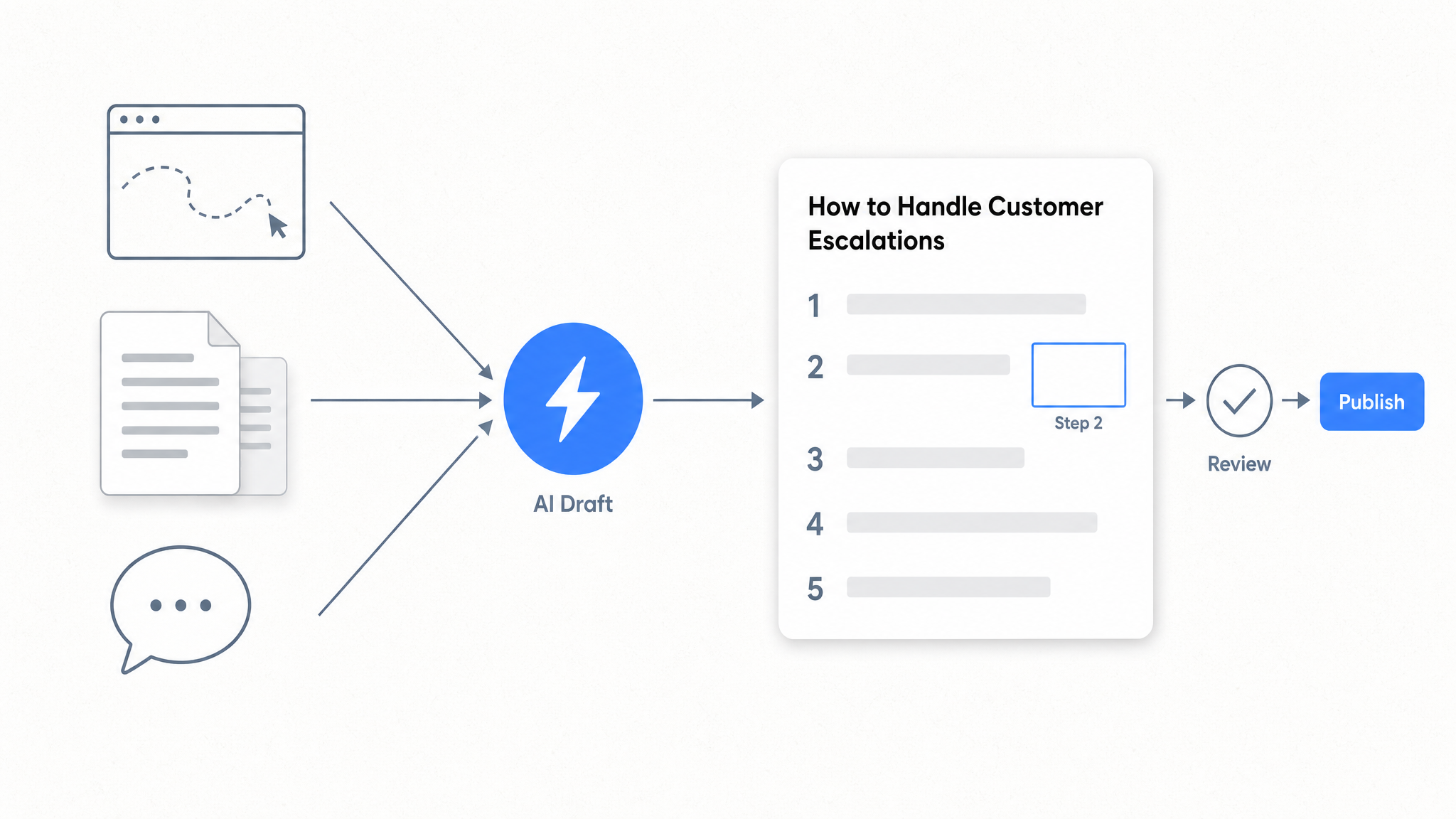
How to Automate SOP Creation with AI
Capture a workflow, let AI draft the SOP, review it, and publish it to a searchable knowledge base your team can query around the clock.
Ready to get started with Dewstack?
Try Dewstack free for 7 days. Create AI-powered documentation that answers questions instantly.
No credit card required.